System 180®
Der Dreiecksträger, mit dem im Dezember 2015 ein Flügel ins erste Obergeschoss gehoben werden konnte, steht seit 2017 an der nordöstlichen Ecke der Doppelhaushälfte (letztes Bild).

Szenografie, Design, Architektur
System 180®


Der Dreiecksträger, mit dem im Dezember 2015 ein Flügel ins erste Obergeschoss gehoben werden konnte, steht seit 2017 an der nordöstlichen Ecke der Doppelhaushälfte (letztes Bild).
Stiftung Schulpforta, Naumburg OT Schulpforte


Gemeinsam mit Dr. Holger Kunde (Naumburg an der Saale) erstellten wir die Machbarkeitsstudie für einen ehemaligen Rinderstall mit Molkerei und darüber liegendem Heuboden auf dem Gelände der Landesschule Pforta.
Willibrordi-Dom zu Wesel


Nach der gelungenen im Jahr 2009 fertiggestellten Dauerausstellung Dom-Zeiten – 16. bis 20. Jahrhundert – eine Bildfolge im Dom zu Wesel beauftragte uns 2017 der Willibrordi-Dombauverein e.V. mit dem Entwurf eines ›Welcome Desk‹.
Footbridge 2017, Conference 6–8.9.2017 TU-BERLIN


Since I’ve been dealing with tubes with flattenend ends over the past 30 years, our occupation here is constructing a bridge out of small tubes, which all together constitute a large tube in form of a pedestrian bridge. Themes like sustainable design, resource-saving materials, minimizing costs by planning and creating something new out of old but best practiced materials are the main thoughts for this structural concept. A modern construction that fits into its environment, that is actively used while it has a welcoming design are important issues for planning a bridge.
The proposed footbridge is basically designed by a string of triangles. The advantage of the design is that there is only a little construction height below the footpath. Therefore, the bridge does not have to be built at a high ground level. Instead there is a respectable height over the footpath that helps to minimize the internal forces inside the construction.
The design of a tube with numerous small tubes produces many joints. To minimize costs, a system with simple nodes must be found, while the nodes have to fit with the tubes. The design basically consists of two types of tubes, one as a net following the surface of the cylinder, the other to reinforce tangents of the profile. To prove the idea, we checked an existing tubular steel system.
Tubes in two lengths and two forms of the so-called „System 180“ are screwed together and form a large tube in their composition. System 180 consists of tubes made out of stainless steel that ends are flattened. The centres of the flat ends are drilled. The diameter of the hole corresponds to a quarter of the flattened end of the tube. By this composition, the German law of steel construction becomes fulfilled (the double of the length of the diameter to the edge in direction of power). The special features of System 180 are the four projections extending from the flattened end of each tube, which fit into four cavities on the other side of the flattened end of the tube it becomes connected with.
The combination of projections and cavities increase the strength of the joint by 50% compared to connections held by bolts only. By calculating a construction made from System 180, the static specification of the tube can be transferred to the joint. Thus the calculation is quite simple – the important proof focuses on buckling, other proofs like tension or forces within the knot have not to be considered. The area where the tube goes into the disc made by the flattened end is weak concerning bending in one direction. Accordingly by designing a structure, it is important to support the weak part, which is normally solved by constructing triangles.
Since the load-bearing construction overlaps the running path, a rain protection is conceivable without additive surface mounting needed. Snow and ice are largely excluded. Handrails and for example, visitor guidance systems and signposting can be attached to several joints easily without creating additional bends in the construction. To form the length of the bridge, the flattened ends of the main tubes must be bent at slightly different angles.
Every part of the construction is contributing to strength, like a net in the shape of a tube with a diameter of approximately 3.50 m. The construction is light and the costs are reasonable. All parts are made of brushed stainless steel without any coatings. For forming the tubes and for mounting the construction no welding is necessary. This proposition of how to construct a footbridge out of tubes is ecologically sensitive. The material used integrates itself gently into the environment through its reflective surface while having a long duration. The bearings can be minimized, since no horizontal forces act in the ground. It is a truism that bridges serve to connect. But, in fact, it is quite rarely mentioned, that disconnection precedes separation. In its appearance, the construction is light, the connection of several tubes and in its result the combination of triangles gives it a dynamism and modernity.
Gelehrtenzimmer, Torhaus Zeitz


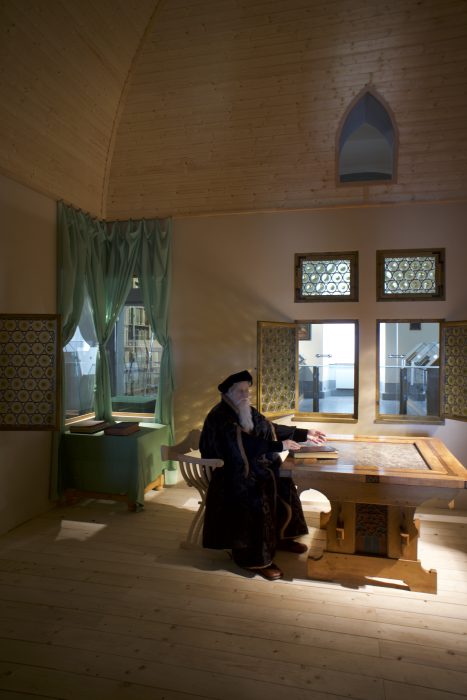


Für die Ausstellung ›Dialog der Konfessionen – Bischof Julius Pflug und die Reformation‹ und über die Laufzeit hinaus wurde im 2. Obergeschoss des Torhauses das ›Arbeitszimmer‹ Bischof Julius Pflugs im Stil der frühen Renaissance als Raum im Raum gebaut.
Neugestaltung des Showrooms in Berlin-Adlershof


Am neuen Standort von System 180 in Berlin-Adlershof – in „Deutschlands modernstem Technologiepark“ – erwartet die Kunden ein vollkommen neues Showroom-Konzept rund um das Thema Modularität und Nachhaltigkeit. Alle Teile, die zur Eröffnung der neuen Produktionsräume zusammengestellt werden, gehören zur zukünftigen Grundausstattung.
Wettbewerb, Berlin


Inspiriert von der Originalausgabe der Lutherbibel präsentiert sich das Denkmal Martin Luthers und damit seine Hinterbliebenschaft dem Publikum auf emotionale und einladende Weise.
Konzept zur Überarbeitung der Fundstelle des Neandertalers in Form von sieben ›Interventionen‹


Nachdem wir beim Werkstattverfahren Neandertal überzeugen konnten und das zentrale Moment, ein Turm der zum virtuellen Ort der Kleinen Feldhofer Grotte führt, in einer Überarbeitungsphase weiterentwickelten, wurden wir damit beauftragt das Konzept zu vertiefen und auch den Weg vom Museum zum Fundort in Form von fünf ›Interventionen‹ zu gestalten.
Stadt Dortmund und Dortmunder Actien-Brauerei


Als Folge des sommerlichen direkten Sonneneinfalls in die Räumlichkeiten des alten Maschinenhauses ist ein zunehmendes Verblassen der dort präsentierten Exponate nicht auszuschließen. Außerdem erhitzt sich der Raum im Sommer auf Temperaturen, die einem Museumsbetrieb nicht zuträglich sind.
Ausstellung in der BDA Galerie Berlin, 26. November – 28. Januar 2016


Die BDA Galerie zeigt bis zum 28. Januar 2016 die Ausstellung Der Himmel über Berlin 40/40. Mit der Schau setzt der Bund Deutscher Architekten, Landesverband Berlin seine 2010 initiierte Reihe zu aktuellen Themen der Architektur- und Städtebaudiskussion in Berlin fort und wendet sich den Potentialen des Raums oberhalb der Berliner Traufe zu.